The Critical Role of Closure Devices in Fire Stopping Combustible Pipes
The Importance of Closure Devices in Fire Stopping Combustible Pipes
Fire safety in modern buildings relies heavily on compartmentation, the practice of dividing structures into fire-resistant sections to contain fire. However, this strategy is often compromised by service penetrations such as plastic pipes, conduits, and ducts. Where combustible pipes pass through fire-rated walls or floors, closure devices become essential to maintaining the integrity of these compartments.
Why Combustible Pipes Are a Critical Risk
Combustible materials such as PVC, PE, and PP pipes present a unique challenge in fire scenarios. When exposed to heat, these materials soften, deform, and eventually melt. This process leaves open voids in fire-rated elements, creating a direct pathway for flames, hot gases and smoke to spread between compartments.
Even relatively small penetrations can have serious consequences, for example a single small-diameter pipe can allow significant smoke passage, undermining compartmentation and putting occupants at risk .
The Role of Closure Devices
Closure devices, such as intumescent pipe sleeves, collars, and wraps, are specifically designed to counteract this risk. Their function is twofold:
- Fire containment: When exposed to heat, intumescent materials expand dramatically, closing off the opening left by a melted pipe.
- Compartment reinstatement: They restore the fire resistance of the wall or floor, ensuring it performs as originally designed.
Without these devices, the effectiveness of passive fire protection systems is severely reduced, allowing fire to bypass barriers intended to contain it.
Case Example: Nullifire FP220 Service Sleeve
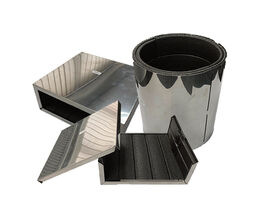
A clear example of an effective closure device is the Nullifire FP220 Service Sleeve. This product consists of an intumescent core housed within a stainless-steel shell and is specifically engineered for use with combustible pipe penetrations.
Key characteristics include:
- Intumescent expansion: In a fire, the sleeve expands to seal the void created by the collapsing pipe, reinstating the fire rating of the compartment
- Fire resistance: Tested to EN 1366-3, it can provide up to 120 minutes of fire protection
- Versatility: Suitable for both retrofit and pre-installation scenarios across a range of building types
- Ease of installation: Its slim, no-fix design simplifies on-site application
Importantly, products like the FP220 are used as part of a tested system, such as with coated batt solutions, ensuring compliance with fire test standards and regulations.
Integrated Fire Stopping Systems
Effective fire stopping is rarely achieved with a single product. Instead, it involves a system approach, combining:
- Closure devices (e.g. service sleeves like FP220)
- Fire-resistant backing materials (e.g. coated batts)
- Intumescent sealants for annular gaps
Such systems are tested together to ensure they perform reliably under fire conditions, particularly with combustible services.
Conclusion
Closure devices play a vital role in safeguarding buildings against the spread of fire and smoke through service penetrations. In the case of combustible pipes, their importance cannot be overstated as without them, compartmentation can fail rapidly.
Solutions like the Nullifire FP220 Service Sleeve demonstrate how modern fire stopping technology addresses this challenge, combining intumescent fire sealing with practical installation benefits.