Nullifire Fire Tested White Wall Systems
Nullifire Fire Tested White Wall Systems
Understanding “White Wall” in Construction
In modern commercial and industrial construction, the term white wall typically refers to fire rated sandwich panel wall systems which are prefabricated structural wall elements with non-combustible cores and smooth facings that often appear white or light-finished once installed. These systems are engineered to provide structural separation, insulation, and fire resistance, making them key components in compartmentation strategies that slow or stop fire spread within a building.
White wall panels usually consist of steel or metal facings bonded to a fire-resistant core (often rock mineral wool) that can achieve certified fire resistance classifications. White wall designs are common where aesthetics, hygiene, and performance are simultaneously required.
Where White Walls Are Used
White wall systems are deployed in a range of building types:
- Industrial and logistics buildings, where internal fire separation and rapid installation are critical e.g Data Centres
- Commercial and institutional spaces, such as offices, hospitals, and educational facilities, where fire-rated partitions are legally required.
- Clean environments, including food processing and pharmaceutical facilities, where clean finishes and durable wall surfaces are priorities.
Their prefabricated nature accelerates installation timelines.
Fire Stopping White Wall Systems
While the wall panels themselves may achieve high fire-resistance ratings in standalone tests, the firestopping details at penetrations, joints, and service openings are critical to achieve compliance.
Nullifire’s Tested Firestopping Details for Paroc and Trimo White Wall Systems
Nullifire, known for providing passive fire protection systems, now has tested details for both Paroc and Trimo White wall systems
1. Paroc Panel System Sandwich Panels
Nullifire has published firestopping guidance and tested solutions specifically aligned with Paroc Panel System sandwich panels. These details demonstrate how firestopping products restore fire resistance when services penetrate or interrupt the sandwich panel wall. The guidance, available in the Nullifire Firestop Guide for Paroc Panel System, outlines products and configurations that have been tested to ensure fire performance is maintained.
These details are critical because simply sealing gaps with generic materials does not guarantee that a wall system’s fire-resistance rating will be upheld once penetrated during construction.
2. Trimo Trimoterm Sandwich Panel Details
For Trimo fire-resistant sandwich panels (such as the Trimoterm range), recent technical documentation jointly tested with Nullifire and partner manufacturers (e.g. Roxtec) shows firestopping details for service penetrations including pipes, cables, and cable trays. These details include requirements such as:
- Aperture framing with composite fibreboard and fire-resistant acrylic sealant.
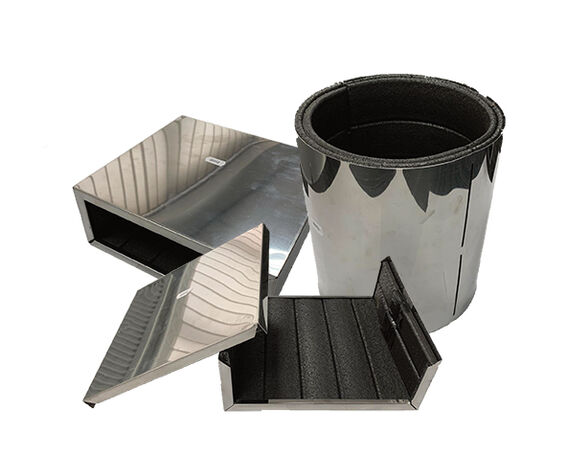
- Intumescent wraps for combustible pipes.
- Steel framing and spacing criteria for maintaining EI 120 performance.
These tested application details document exact installation configurations and materials that have been verified by fire testing according to recognised standards. They represent approved methods for maintaining integrity and insulation performance in assembled wall constructions rather than theoretical or best-practice recommendations.
Industry Trends: Increasing Use of White Wall Systems
Construction continues to move toward off-site and modular methods, where controlled fabrication, repeatability, and speed are valued. White wall panel systems fit well in this trend because they:
- Reduce on-site time and labour requirements.
- Provide predictable thermal and acoustic performance.
- Deliver clean, uniform finishes that suit modern architectural requirements.
As buildings get larger and more complex, white wall systems are becoming more common, not just in industrial facilities but increasingly in commercial and mixed-use developments.
The Importance of Passive Fire Protection for White Walls
Despite their factory fabrication and high fire resistance ratings, white wall systems must be properly detailed with passive fire protection measures:
- Firestopping products and tested installation details ensure that service penetrations, joints, and transitions do not become weak points for fire or smoke spread.
- Regulatory frameworks increasingly require evidence-based solutions. Fire performance that is demonstrated through third-party test reports and certified installation details.
- Using untested or assumed firestopping methods on white walls may result in non-compliance and compromise occupant safety.
Passive fire protection including fire-stop seals, cavity barriers, intumescent products, and certified joint systems is an essential part of safe building design. For white wall systems, where the panels themselves provide structural barriers, the firestopping at interfaces is as critical as the panels’ own fire-resistance performance.
Conclusion
“White wall” systems are advanced fire-rated sandwich panels that deliver high performance in fire safety, insulation, and build quality across industrial and commercial construction. However, the real benchmark of safety lies in how these systems are integrated with passive fire protection especially firestopping penetrations.
Nullifire’s tested firestopping details for Paroc and Trimo panel systems provide designers and contractors with verified installation methods that uphold fire resistance once services are installed, a vital link between product performance and real-world safety.
As construction continues to adopt white wall systems for their versatility and efficiency, the importance of tested passive fire protection solutions is only increasing ensuring that buildings not only go up quickly but also protect people and property effectively throughout their life.